

Wife Guys
Millennials Love Their Wives, Gen Z Hate Their Boyfriends


There’s this blonde couple that you probably remember popping up quite a bit on your feed during COVID. The pair looks like they’re siblings or from Utah, or both. The man is what a 2020 internet would dub “a golden retriever”: perpetually smiley, upbeat, slightly aloof, and noisily feminist. His name is Hunter, and his wife is named Maya, together they’re @mayaandhunter.
The account blew up during lockdown when Hunter would post “Day in My Life as a Stay-At-Home Husband” content, in which he would engage in domestic tasks while making sincere quips about “dismantling the patriarchy.” Their comments section was and is replete with women crying, “Why aren’t all men like this??” and “May this love find me.” The couple makes many jokes about Maya being the breadwinner and Hunter being utterly comfortable with being the homemaker. In one video, he’s asked to “shake his moneymaker,” and in response, he grabs Maya and jokingly shakes her around.
Similar to any other domestic content creator, like Nara Smith and Hannah Neelman, Hunter doesn’t completely lack an income, despite what his online presentation might suggest. While he doesn’t lead with it in any of his videos, he had been enrolled in law school and studying for the bar for the first half of the 2020s. Unlike Maya, who had been working a full-time job at her family’s manufacturing business, at least at one point, Hunter may have had a more flexible schedule, allowing him to engage in more of the domestic labor. But they certainly don’t lead with any of this knowledge, flirting with rage bait to earn views and playfully interrogating haters in millennial-optimistic tones.
I hadn’t thought about this couple for a while, until I attempted to watch the most recent season of Beef. The latest addition to A24’s catalog of exposition-dense, eating-the-rich media centers a power-hungry middle manager at a SoCal country club and his British, aspiring interior designer wife. A conflict sparks when two young employees at the country club, who are in deep puppy love, catch the manager and his wife aggressively fighting, witnessing the husband threaten to hit his wife with a golf club. The young couple, played by Charles Melton and Cailee Spaeny, get a video of this fight, and muster up the courage to use it as blackmail to get a higher salary and health insurance.
I couldn’t tell you what happens next, as the writing was too trite for me to continue watching. But what did keep me hooked for at least the first two episodes was the relationship between Charles Melton and Cailee Spaeny’s characters. While the characters are 29 and 28 years old respectively, they possess sweetly juvenile notions about life and love, at one point lamenting that they only need each other and the beach. They’re deeply sensitive, working through relational conflict with airport self-help book platitudes and pop psychology terms far from their original context. Very “I hear what you’re saying, babe, I’m validating your emotions,” and unwavering confidence in each other’s ability to achieve medium-sized professional goals.
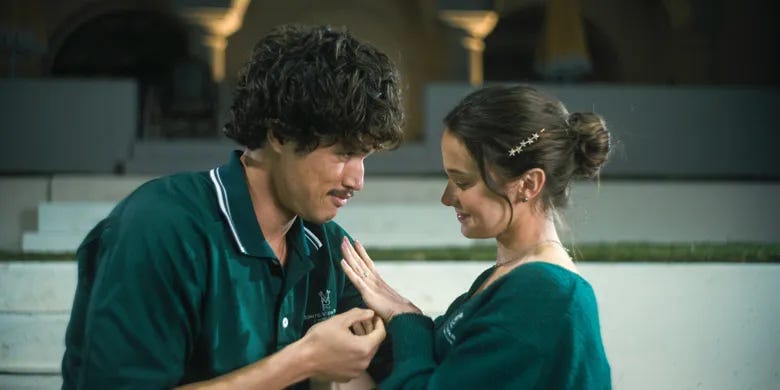
Melton expertly brings this type of soft boy, Girlfriend Guy, to life. It’s the type of serial monogamist guy I’m assuming many of us knew in middle and high school. Vaguely Mormon-feeling somehow, gentlemanly to the detriment of his swag, rigidly assuming the role of Prince Charming since the day he took his first date to a sixth-grade dance. Some might describe this type of man as “whipped,” but in my eyes, that carries a different, more negative connotation of coercion. A “whipped” partner doesn’t make any moves without his wife’s okay, remaining firmly at her hip like a Labrador.
The Girlfriend Guy, or more commonly the “Wife Guy,” does not lack a sense of self. Rather, being a husband is one of the more major facets of his identity. He brings his wife up any chance he can to innocently brag about her, or purely because she’s the person he likes to talk to and about most. I’ve encountered this type of man in corporate social settings. He’s typically a decade or two my senior, and I usually find him pretty charming. I find it endearing to see a man’s face light up at the mention of his wife, as it still occurs only occasionally. It’s still not uncommon to hear men grumble about their wives, or drop the sporadic “My Wife” joke, especially when they’ve had a few drinks at a Thursday night happy hour.
However, the Wife Guy influencers are of a different breed, heavily playing up their attachment to their significant other for the camera. And they’re usually just one half of the package, as Wife Guys are most successful online when audiences can see them spoiling their wives in real time.
While Maya and Hunter are the anti-partriarchy influencer couple, Matt and Abby Howard are the we’re-not-regular-parents-we’re-cool-parents couple. They have a kind of rabid, Disney Adult hyperactivity; the aforementioned millennial optimism on crack. The millennial identity is characterized as a child with the responsibilities and bank account of an adult, and that certainly colors how Matt and Abby discuss marriage. Their videos are flush with anti-adulting quips about marriage, in the vein of “You mean we get to have a sleepover every night?” and “Wait, can you believe we get to grow old together!!!”
Noah and Lori, on the other hand, play antagonists, acting out the role of an aunt and uncle who are constantly, half-jokingly nipping at one another. The juvenility persists, with the pair posting videos captioned “Normalize tickling your husband for 15 seconds when he makes you mad” and “Loving you is so fun,” wherein Lori hangs on Noah like a koala bear. These types of couples are also known to act out “skits” of sorts, typically involving one of them speaking to the camera about the other partner, while the partner stands behind them and laughs or tries to interject.
Mushy, infantile millennial couple content sharply contrasts Gen Z’s more nihilistic #ihatemybf content, which also leans partially sarcastic. Many Gen Z girls are fond of talking down on their boyfriends online, posting videos captioned “When he’s talking down on himself but I highkey agree so idk what to say.” This attitude mirrors the stereotype of Gen Z being more fluent in snark and more rife with realists than ever-sparkly millennials. Though millennial women pioneered the girl boss generation, Gen Z women have taken “I hate men” sentiments much further and more literally.

There is nothing immediately wrong with Wife Guy content creators and corny millennial couples, beyond their sickly sweetness making me nearly faint from second-hand embarrassment. But there is something rather icky about the way everything, and I mean, everything, they do is made into content. It’s well enough established that oversharing online is taboo and that highly parasocial influencers give us the heebie jeebies. Perhaps my prudish attitude towards PDA is tinting my view, but I do think some aspects of romantic relationships should be purely between you and your partner. The kooky, absurd aspects of romance that only happen behind closed doors are part of what makes relationships sacred, even beyond the more out-of-body, stars-in-your-eyes aspects of love. I don’t, for example, need or want to know the stupid names you call each other, or the fact that you maintain conversation when one of you is taking a shit. Keep those ridiculous, stupid things secret, so they remain sacred.
I’m also often very suspicious of men who need to make a big show out of doing an act of kindness for their girlfriend or wife, as it often reads as though they’re asking for a pat on the back. Maya and Hunter have an ongoing series in which Hunter cooks food for Maya to help her recover from her ED. He explains each component of the meal to the camera, before setting the plate before her and offering a quick peck on top of her head. This is once again a kind of act of kindness that feels most precious to me when it’s exchanged between two people, and not broadcast to the public.
But then again, I guess I have to remember that social media is now a big part of how young people figure out how to treat their partners, how they learn just about anything. Maya and Hunter are to budding millennial and Gen Z couples what Barbie (2023) was to much of the United States; explicitly spelled-out manuals for how to broadly prioritize gender equality, manuals that still likely won’t be clear enough. Influencers perform, and romance and chivalry are virtues that we’ve long enjoyed having acted out for us. I shouldn’t be so surprised that it’s being eaten up so readily.
"But there is something rather icky about the way everything, and I mean, everything, they do is made into content." It's very icky!!! People forget that you can just have a private bit and not film it into a skit for content. Combined couple accounts always weird me out!!!
Great essay! Beyond the points you have made already, one thing that feels slightly off about the “wife guy” trend is whether performative chivalry is ultimately a substitute for deeper understanding or connection. There is a saccharine, superficial quality to it. Pleasant sentiments and acts of kindness are better than the alternatives, but is this a Hallmark card alternative manifestation of heterofatalism, where nice words and gestures are an attempt to traverse a gulf of lack of understanding.