

Where Are the Rock Bands?
Rock Identity Post-Irony

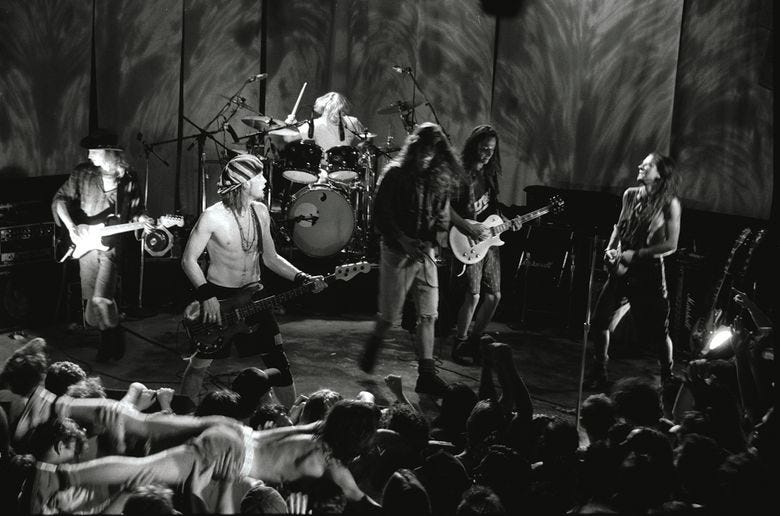
I can’t pinpoint the moment precisely, but at some point in my childhood, I came to believe that rock bands were going to be a much more important part of my adulthood than they’ve ended up being. Perhaps it was the many portrayals of garage bands I ingested via films like Freaky Friday (2003), Jennifer’s Body (2009), and Diary of a Wimpy Kid: Rodrick Rules (2011), or The Killers and Green Day soundtracking various suburban-set, coming-of-age films and CW originals throughout the 2000s. My family car rides were accompanied by a wide range of bands from Guns N’ Roses to No Doubt, along with anecdotes from my parents about the concerts they attended in the 80s. Born and raised in Seattle, I learned very early on that grunge band culture was baked into the fabric of my city. Eddie Vedder and Chris Cornell were among my mom’s top celebrity crushes.
When I was in middle school, harder rock gave way to indie, with bands like The 1975 and Arctic Monkeys being among the trendiest groups to stream. Millennials, who were then the older siblings and babysitters of my close friends, favored Passion Pit, Cage the Elephant, and Kings of Leon. I, lamely, stanned 5 Seconds of Summer, and attempted to get into bands they cited as inspiration, like Blink-182 and Good Charlotte, which is very brave of me to admit, everybody clap.
Young adulthood, according to the movies, was a montage of catching a friend’s band play at a local bar and bumping into your soulmate in the crowd, or being the dreamy girl in the front row, swaying with her eyes closed, adrift in the music. On and off screen, the more obscure-sounding your favorite band was, the more culturally attuned you were. Those who revered pop stars were ditzy, shallow, and artistically underbaked. Those who listened to bands that played real, loud music, with real, weighted instruments were emotionally in-touch cerebral tastemakers. This was at least the world as I saw it, as a girl who felt a natural draw to melodramatic pop stars, but ventured deep into the annals of indie bands’ discographies in an attempt to convey good taste and high intellect.
Today, however, rock bands, and bands in general, have dissipated in mainstream culture. They’re undoubtedly still around, and I’m sure many of you listen to them. But they don’t play as big a role in monoculture as they did decades ago.
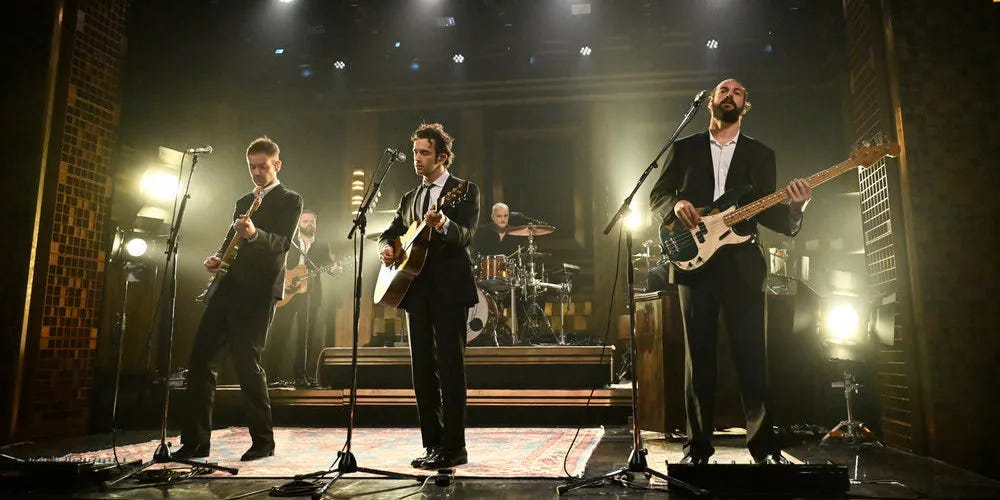
A couple of years back, the podcast The Rest is Entertainment pointed out that in the first half of the 1980s, there were 146 weeks in which a band held a number one chart position. In the first half of the 1990s, there were 141 weeks when bands held a number one spot. But in the first half of the 2020s, there were only three weeks in which a band reached the top chart position.
For The Guardian, Dorian Lynskey ponders the many reasons why bands have fallen off. While the pop genre has always been dominant, it seems to encompass even more mainstream listenership than it did in decades past, nudging rock and even hip hop closer to the periphery. There are several reasons for this. For one, the barrier to entry for making bedroom pop on your computer is far lower than garage rock; no instruments or rehearsal space required.
Lynskey also writes that selling multiple personalities to audiences is much trickier than launching a single one. It takes much more skill to convey the idiosyncrasies and dynamics of a group, and perhaps a longer form of media and a sturdier attention span. He writes that the MTV era of televised music programs made formalized band introductions more straightforward. Today, most people are finding new music through Spotify and TikTok algorithms, both of which remove artists from their particular contexts, compiling them into a kind of monotonous sludge of clips and soundbites on a feed. Lynskey points out that even the portrait orientation of an iPhone video for a TikTok is more tailored to a solo artist than a group, as you can’t fit everyone in the frame.
The punchiest voice always wins online, and the voice of a group is naturally a bit more muffled. Unless, of course, the group is a pop boyband or girl group, in which every member is engineered to be highly singular, each person fulfilling a different, but equally potent archetype. In a rock band, the separate players, while impressive on their own, are their most extraordinary when put together.
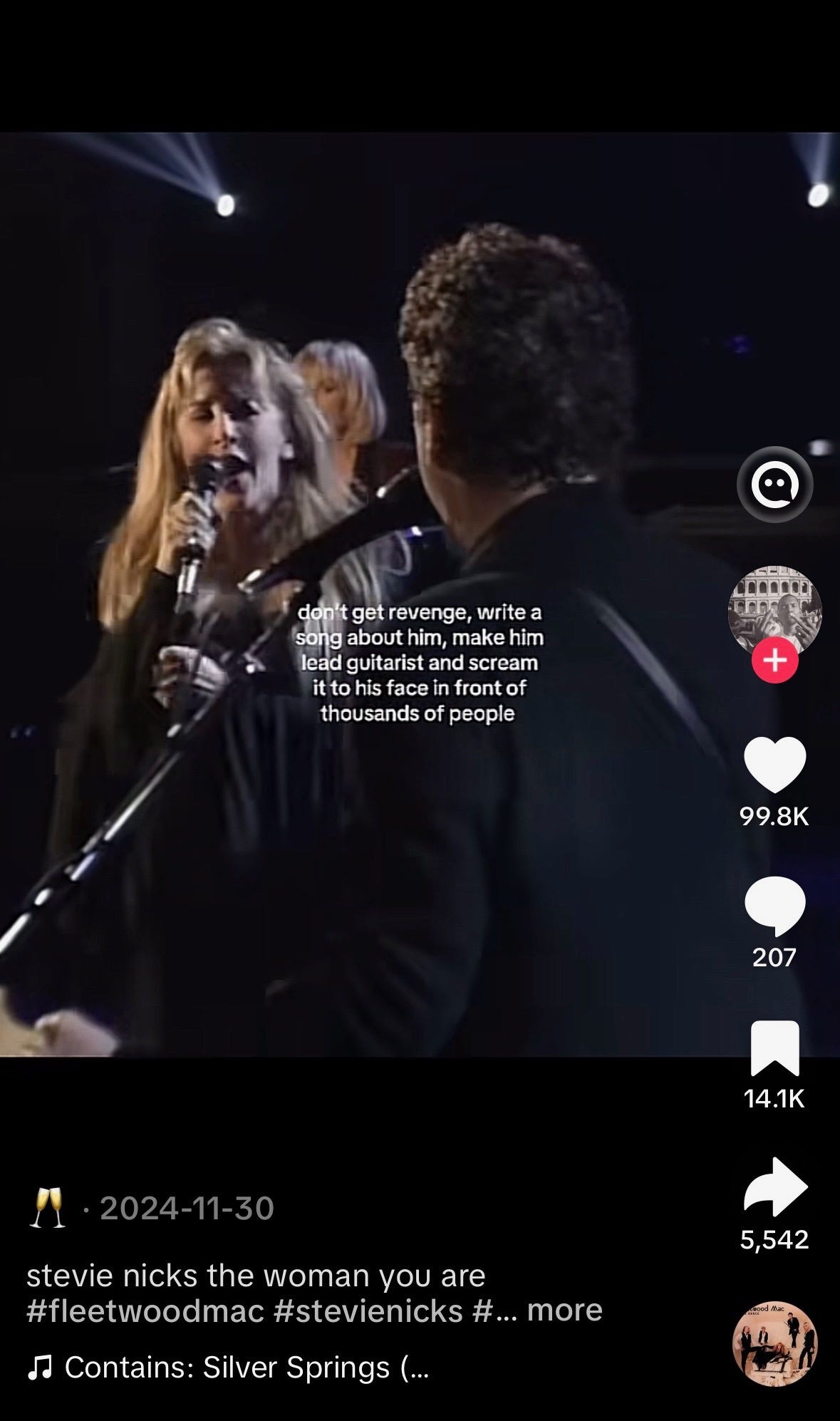
Interestingly, just because there’s less mainstream noise surrounding bands doesn’t mean there isn’t a curiosity about them. The cross-generational enthusiasm surrounding Geese makes this abundantly clear. As does the internet’s tendency to romanticize Fleetwood Mac’s 1997 “Silver Springs” performance, in which Stevie Nicks sings the bridge directly to Lindsey Buckingham, which was later replicated in the YA novel turned Amazon Prime series Daisy Jones and the Six. There’s clearly a mild interest in the relational drama that can unfold within band dynamics.
But modern curiosity about bands still feels deeply rooted in nostalgia, which will undoubtedly hinder bands from developing contemporary identities. boygenius’ 2023 Rolling Stones cover was a direct reference to Nirvana’s 1994 cover. And whenever Geese is brought up by an esteemed outlet like The New Yorker, they are simultaneously praised for “reviving” a certain style of rock n’ roll, as well as pioneering a new style of music.
Whatever the future of “rock” is will certainly differ from whatever it looked like in the past, not only because more synthetic instruments are intervening, but because the post-TikTok generations are apprehensive about holding sincere eye contact, Gen Z Stare notwithstanding. Rock bands are classically confrontational and sweaty, their eyes and vocals piercing an audience that returns energy back at them. You can feel the crackle of electricity flickering between the crowd and the performers. In contrast, I’ve seen far more people in my generation try to become DJs than try to start bands. And today’s layman DJs occupy a more reticent, stereotypically Zoomer role than bands at functions: head down, eyes and hands busy with their computer, the audience members gyrating in their own bubbles.
Having grown up completely on the internet, Gen Z and Gen Alpha are also far more aware that everything is a performance, leading them to double down on their virtues of irony and disaffection, staring blankly rather than with their eyes and mouths agape. They know that even a performance of authenticity is still a performance, especially when it’s mediated through a screen or acted out on a stage. This perhaps draws them closer to artists who more openly and deliberately curate themselves, most of whom play in the pop space. Rockers, on the other hand, are typically conceived as far more genuine, evoking the image of misfits spontaneously finding each other, jamming in their parents’ garage. To younger generations, “authenticity” in music may be less about having a stripped-back facade and more about being honest about what that facade is intending to convey.

Charli xcx is a pop artist who has succeeded in feeding Gen Z sincere sentiments coated in a healthy gloss of irony. In a recent profile, British Vogue revealed a line from a song off Charli’s forthcoming album and standalone follow-up to Brat: “I think the dance floor is dead / So now we’re making rock music.” British Vogue ran with this, misleadingly sub-titling the piece “Charli XCX Lets Vogue In On Her Rock Reinvention,” priming audiences for the pop star to make a complete pivot into rock.
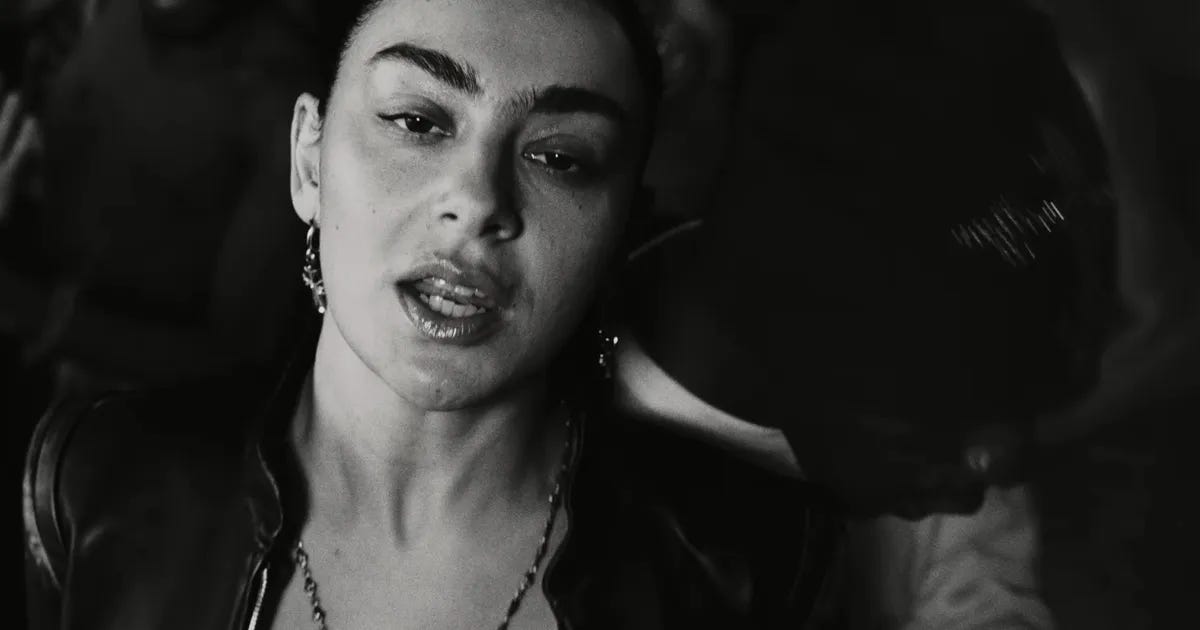
A few weeks later, Charli released the song containing the lyrics in question, fittingly titled “Rock Music.” While the track contains a chorus of highly distorted guitars and cymbals, it’s unmistakably a pop song, reading as a playful poke at rock’s, at times, melodramatic conception of “authenticity.” The lyrics seem to suggest that “repackaging” is necessary for pop stars, like herself, to be received seriously and with sincerity, in the way rock stars often automatically are. “Wow, I’m really banging my head / I’m really hurting my neck,” Charli drawls in the second verse, deadpan. In the music video, she trashes a hotel room and smokes a handful of cigarettes in a moto leather jacket, ashing them on piles of even more cigarettes.
In response to the song’s mixed reception, Charli has refused explanation, writing in an Instagram post: “i’m not gonna explain where i was coming from with ‘rock music’, but all i know is that things can be funny, earnest, sincere, and joyful all at the same time and that’s what i feel about a lot of the things i make.”
I can envision rock bands making a mainstream return, though the music may sound different than the rock of decades past. And I can only foresee it happening if fans can get onboard with the fact that the rock image and sound is part-manufactured, that deciding to present “authentically” is as much a sartorial choice as pop stars’ latex and glitter. In a recent Substack article, Eliza McLamb wrote about her surprise in finding out that Geese was a client of Chaotic Good, a music marketing firm that helps artists rapidly ascend in popularity, in part, by making hundreds of fake fan accounts to influence public opinion, propagating what many refer to as “industry plants.”
But McLamb, a musician herself, ponders what artist wouldn’t game algorithms if it guaranteed them success? What musician doesn’t want to play music aloud to an audience of thousands? Even Kurt Cobain, who appeared as authentic and “real” as musicians come, was hungry for a large stage. There is, in fact, a cunning side to even the rawest-seeming rock stars, and a soft belly on every product of the pop machine.
Where have the bands gone? They’re still here, assuming new and old forms. But it may be a minute until we see them reach their former chart standings, so long as they continue presenting so earnestly, and the young brain-rotted public, of which I belong, remains so barbed.
Sometimes I wonder if this is partly due to our access to music. In the digital age, music is readily available on streaming platforms like Youtube, Spotify etc, and I've always wondered if this easy consumption ruins some of the magic for us. I'm an avid album listener, but I'm listening to one or two different artists a week. Recently, I've even been making the effort to just enjoy the album longer and ponder on it more so I'm not just consuming and moving on. It's an honor honestly to be able to enjoy so much music at once, but at what point is this just consumption.
When you look specifically at bands like the Grateful Dead, for example, sure they had recorded stuff and records for sale, but their live shows were where the magic was. You had to be there or you missed the 20-minute improvised guitar solo or whatever else they had planned. Fans used to share recordings of different shows with each other by physical media such as CDs and vhs. It was less like a buffet and more like a 7-course fine dining experience.
And also, I'm a pop lover and avid defender, but it's significantly easier to spin out a single artist's pop song as well as more accessible. Like you said with a band, its multiple people interacting and trying to get the music to sound perfect. That's a lot of opinions to put together into a 3-minute song. In Geese's GQ interview, they spoke a lot about creative differences between the band; the crew hired to help them, and with the label. It's a lot more effort that a label has to in to get a new album on the charts.
I just really liked all of your thoughts and I think this is such well put together essay. You're so articulate! I also miss rock bands :( but I'm excited to see what the next wave or "rock stars" have to show us.
people do not understand the art of hateful collaboration anymore, and it shows.