

There Is No Logging Off
On Being a Blogger, Or an Internet Jester

Special thanks to Lenovo for sponsoring this week’s essay! I’m grateful to partner with another brand eager to support emerging writers like me :D
There are many ways to slice and dice your life in retrospect. You can look at it all in terms of triumphs and defeats, ebbs and flows in relationships and career, and so on. You can examine life based on ego deaths and ego boosts. If I were to survey the latter, in my own life, I would automatically put a pin in my senior year AP Literature class.
My teacher, Mr. Kendrick, was a tough nut to crack; what some might call a curmudgeon. It was hard to tell how much of it was a performance of a grumpy English teacher and how much of it was real. He had a scraggly grey beard, a thick mop of hair, and New Balances with three inches of foam. When asked how he was doing, he always had an excessively gloomy response. He only ever drank Diet Coke and only ever sneered when we told him how bad it was for him. He randomly had something like three PhDs, one in philosophy, another in chemistry, and another in something else. He insisted on analyzing every text with a Freudian lens and hadn’t cried since 1990. There was no winning a person like this over, so you can imagine, he was my dream person to win over. This teacher was Paul Giamatti in The Holdovers (2023), and I’m basically Rachel Berry.
After grading our essays each quarter, he anonymized the “best” ones and passed them out as examples for future writing. During my first quarter with him, I remember him passing out thirty copies of my feminist analysis of One Flew Over the Cuckoo’s Nest, an essay I was especially proud of. He praised my strong argumentative structure and unusual angle, sympathizing with Nurse Ratched in a way he hadn’t automatically considered. I was buzzing in my chair; it took everything in me not to raise my hand and lay claim to the accolades.
This was one of those moments that helped me realize that writing should be one of my guiding lights in life. Not only was I receiving ample confirmation that I could analyze text well, but the whole endeavor came much easier to me than other subjects. English was becoming one of my favorite puzzles to sort out. A few years later, I emailed Mr. Kendrick, thanking him for preparing me so well for the English classes I was tackling in college. He didn’t respond, but I wouldn’t have expected him to.
My AP Lit teacher was a tough nut to crack, but the world of professional writing has proven to be even tougher. I haven’t quite gotten to its center, so much as I’ve pried and crawled my way closer, crowbar in hand and dirt under my fingernails.
When the world was on fire in summer 2020, I set forth looking for a journalism internship, like searching for freshly churned ice cream in the middle of a desert. I was able to find ample work that paid zero dollars, either literally or close to that, which was great for a college student living at home. But eventually, the time came to get on with life, and I was ready for it. The academic validation had worn off, and I was eager to do what felt more like Real work in the Real world. But, this Real world I was looking for would turn out to be much more elusive than I initially thought.
This world will always need writers. This isn’t a hope, or a prayer, or wishful thinking from a writer, early in her career. It’s a fact. The world will always need people who can translate the incomprehensible into something intelligible. Translators, elucidators, detanglers. People who can help make sense of the complicated. The institutions that house these people, the technology they use, the platforms on which they publish, and the beats they engage with will necessarily change, as culture and politics change. As the tectonic plates keep shifting and as the number of hours in the day remains constant, it can be hard to determine, with certainty, where exactly to place your focus. Success in any creative pursuit feels like an ever-moving target.
Hungry for a stable start to adulthood and perhaps disillusioned about where I would find professional satisfaction, writing was initially relegated to a side pursuit. But the things we love have a way of staying with us. You can do your best to drown out the ringing in your ear, but it never fully fades, especially in moments of silence. And boredom. It feels best to get things right the first time, but sometimes, we have no choice but to start again.
I want to believe that there is still validity in pursuing a writerly career the old-fashioned way. But there are certainly reasons to be cynical about it. In 2024, the U.S. Bureau of Labor Statistics found a 4% decline in journalism roles. Every quarter, headlines announce yet another legacy publication folding, or another crop of writers getting laid off. In November 2025, Condé Nast announced that Teen Vogue would be folded into Vogue, laying off 70% of the beloved magazine’s staff. Last month, The Washington Post laid off about 30% of its employees, including 800 journalists in the newsroom. Trying to break into journalism increasingly feels like trying to smuggle yourself aboard a sinking ship.
All of this chaos has made me more eager to focus my writing efforts on enterprises that are more in my control, like my newsletter. But, self-starting comes with its own challenges, such as matters of self-promotion, branding, and restraint.
Many of us writing on Substack are smart enough to know that spending too much time on the internet is bad for us, but we do it, at times, necessarily, and at other times, senselessly. Seeing too much short-form stimulation in succession is akin to whiplash, rendering your neck sore and your brain soupy. But the internet is also our meal ticket, and if it’s not yet our meal ticket, it’s certainly our attention ticket, which could lead to actual meals down the road. If we spend enough time performing a free song-and-dance, posting and reposting excerpts of our work, sending Notes into the ether, seeking collaborations with brands and other writers, maybe the free clown routine will turn into a paid one. Maybe we’ll even get to own more of the means of our production than we would working for one of these dying legacy publications.
Still, seeking any kind of external validation in excess is a perilous pursuit. Critics warn us to “touch grass,” instead of engaging with ephemeral online discourse, much of which is engineered to make us angry and get us talking about ultimately nothing at all. The source material for most internet thinkpieces is wisps of smoke or sweaty condensation on the edge of a water glass, destined to evaporate or wipe away in a few minutes’ time. Even as a writer who focuses on internet culture, I often advise readers to engage with more people and problems in the physical world. Concern yourself with reality instead of representations of reality. Remind yourself that you have hands, as well as just thumbs.
And yet, here I am, obsessively checking my subscriber count on my phone’s internet browser. Refreshing my activity feed to see how many likes my recent Notes have gotten. I drink up the engagement like sugarcane juice, desperate for it to save me from a life without creation. I am a writer trying to pave her own way; there is no “logging off” for me. Valerie summed up the situation well for Club Reticent, writing:
“Woman is vain enough to care about money and popularity. Woman needs to log off, but woman wants to be famous on the internet. What’s woman to do? Roll around outside in the dirt? Or push through the chest pressure, reach her arm wide out for a 0.5 photo? Well, for starters, woman is to take a breath. She’s to decide what comes next…She needs to understand why she does what she does and keep her dignity away from the machine.”
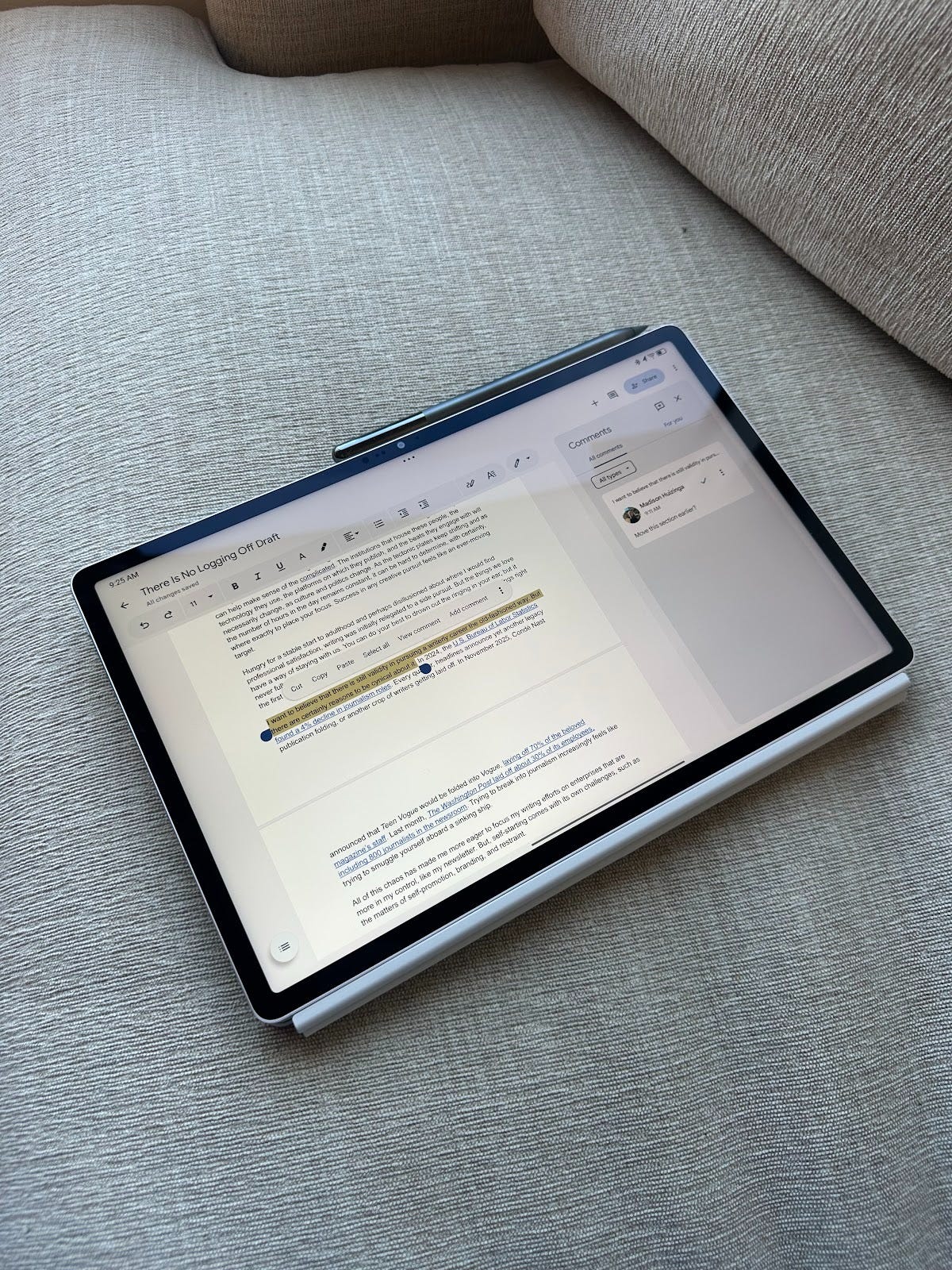
The actual tools we use to ideate and create play a big role in finding a balance between engagement and disengagement. The more that I can limit the role my smartphone plays in my writing process, the better. Even when in one’s pocket or purse, phones have a kind of omnipresence, pulling focus without even being in direct sight. Conventional computers are better, but don’t completely save us. The “+” sign on my laptop’s internet browser taunts me with promised distraction in a new tab. The most balanced I’ve ever felt in my workflow was in college, when I toggled between a tablet and a computer, writing on the latter and annotating with a pen on the former. A tool like the Lenovo Yoga Tab Plus facilitates this more flexible mindset. I like being able to bounce between researching, writing, and editing, typing and handwriting, all on one device, especially when my smartphone is tucked away in a desk drawer or in another room entirely.
On my phone itself, it also helps to keep the short-form on a high shelf, or thrown away altogether. TikTok has been off my phone for nearly four years, and Twitter has been off it for nearly two. This hasn’t just offered me a clearer head, but has also refined the themes in my writing, enabling me to focus on more enduring ideas, rather than flash-in-the-pan trends. Limiting my exposure to short-form media has sharpened my sense of discernment, allowing me a better understanding of what is a Real conversation happening in the Real world, and what’s only consequential in Internet Land. Emily Sundberg recently shared that she deleted the Substack app from her phone altogether. Perhaps this should be next for all of us.
There is no completely divesting from external validation - even the most self-assured writers need confirmation that they’re headed in the right direction. And there certainly is no completely divesting from the internet. But there has to be a way to divest from distraction and noise. The internet is a powerful tool, and I have to believe it’s also an ambivalent one. If there’s any hope in making it on my own, I have to believe I have a choice in using it more responsibly. I just have to.
Meaningful and makes me self reflective ! Excellent
Writers have always needed attention. The internet just turned the theatre lights on all day. The real trick now is learning to use the machine without becoming its clown.