

The Self-Indulgent Tone
Jake Shane, Fan-Hosts, and Performed Closeness

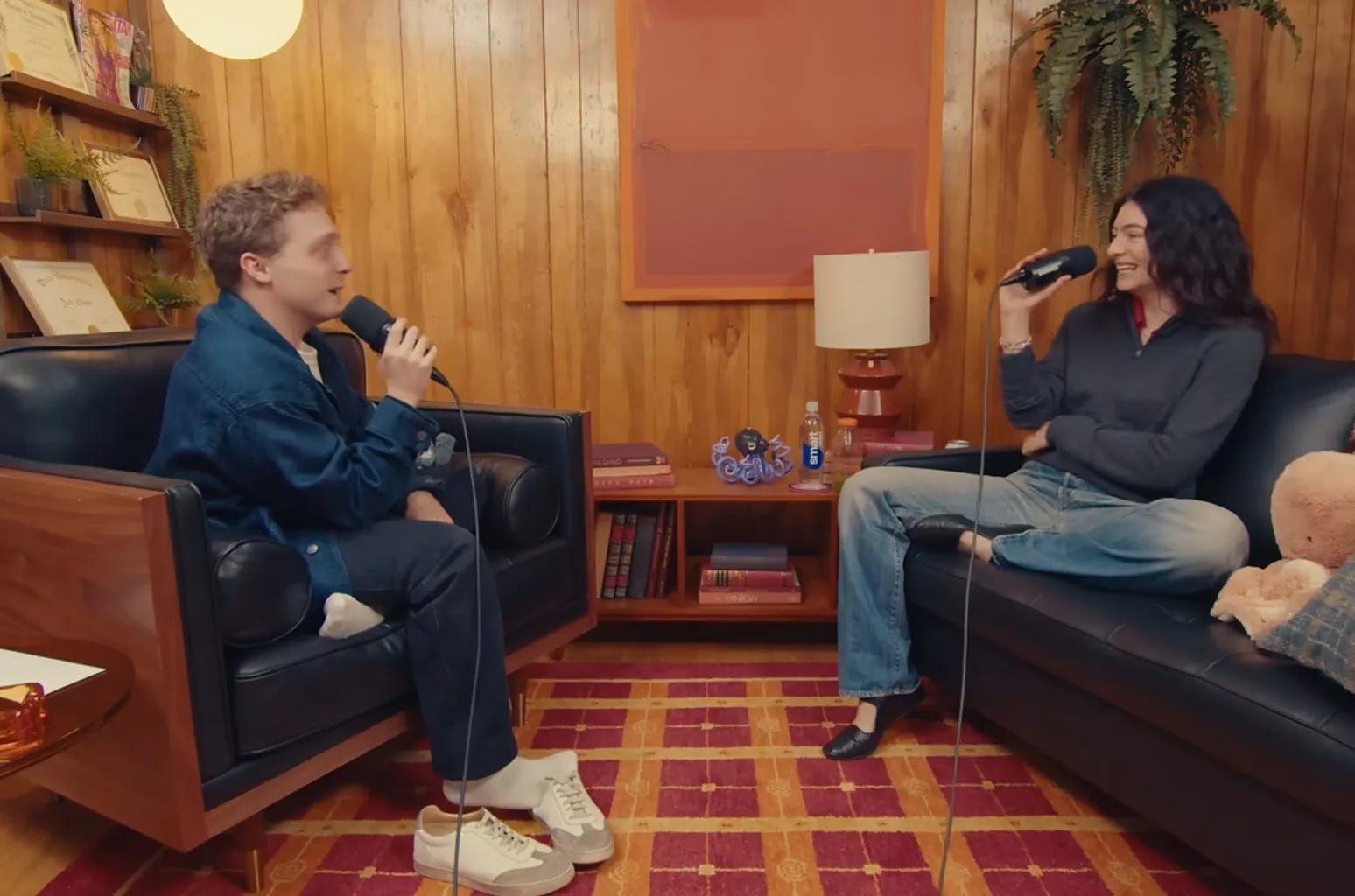
Jake Shane is a character I stumbled across about a year and a half ago, when I was searching for new podcasts to help make time pass at my remote day job. His podcast, Therapuss, had been recommended to me by Apple Podcasts, probably because of the many hours I’d clocked in listening to Las Culturistas. Therapuss has a similar format to Las Culturistas, which has a similar format to nearly every pop culture or comedy podcast nowadays: toss softball questions at celebrity guests who are on the show to indirectly promote an upcoming project.
I steamrolled through a dozen or so episodes of Therapuss while sending follow-up emails and performing Excel shortcuts, which is roughly twelve hours or so of my real, adult human life. The show is so easily digestible that its contents float through your brain like liquid, exiting the mind as quickly as they enter. Due to its highly consumable format, it took me around twelve or so episodes to realize that I don’t find Jake Shane all that personable a host.
Jake rarely prepares questions for his podcast, but doesn’t have a knack for improvising either, instead relying on self-degradation and flattery to establish close ties with his guests. He complains about his own life problems, many of which are trivial complaints about international travel and awkward social encounters, which sometimes elicits sympathy, solidarity, and laughter from the celebrities, breaking the ice so they can “get real” about their own personal problems. But more often than not, the celebrity guest will swallow Jake’s compliments gracefully and laugh along politely, seemingly unsure how to respond to someone who is ultimately a stranger, even if they’re divulging a good deal of personal information.
Jake Shane speaks to the celebrities on his show in the same manner that a stan Twitter account might post esoteric complaints about their personal life behind an avatar of their idol. But unlike stan Twitter, there is no anonymity, and Jake, who is a self-proclaimed fanboy himself, is voicing these esoteric complaints into a hot mic, directly in front of the idols themselves.
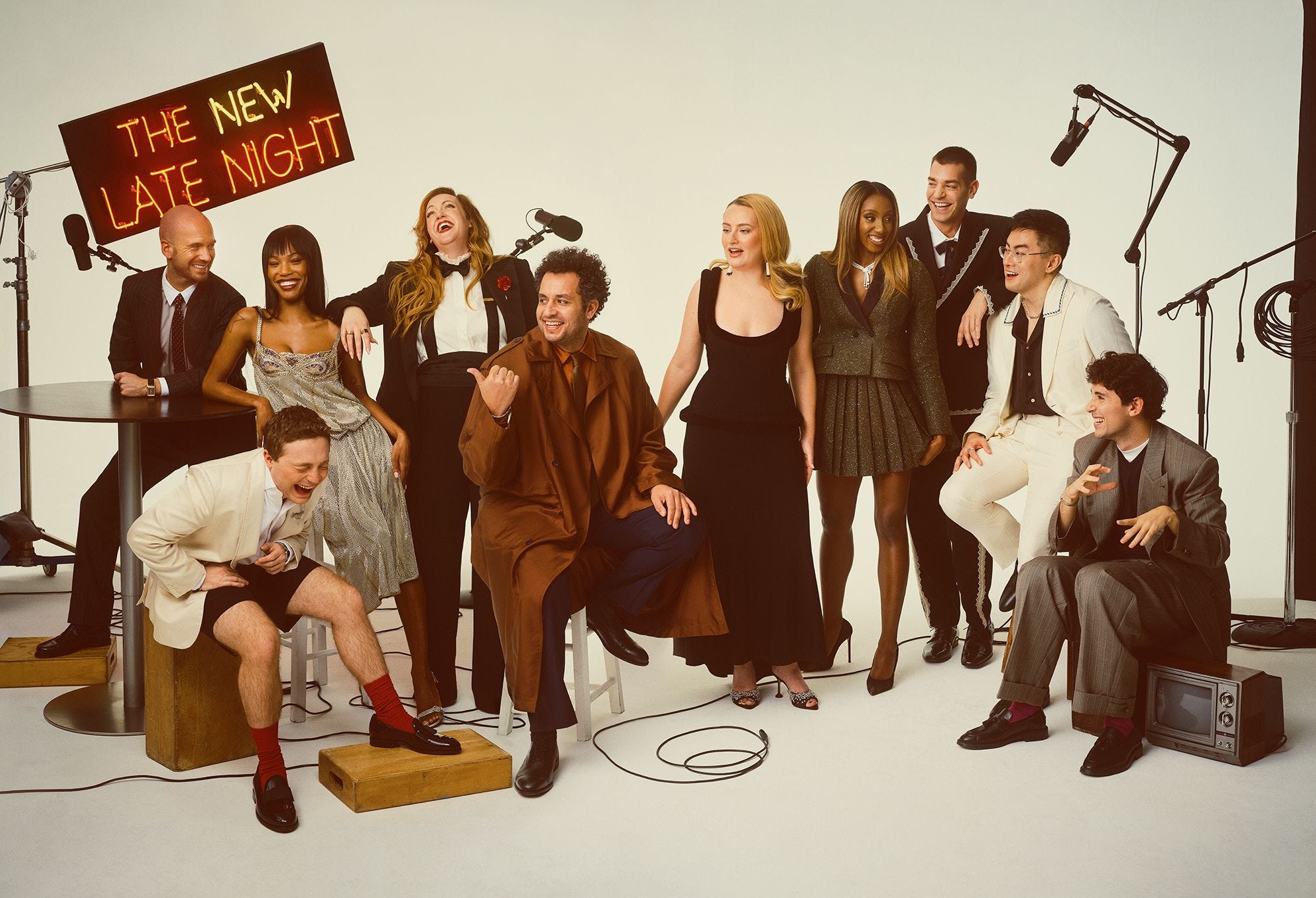
This kind of host-fan hybrid is the new norm for podcast and internet show hosts, which many foresee replacing late-night television altogether. In February, Vanity Fair published a story about “The New Late Night,” interviewing podcast and YouTube series hosts like Sean Evans of Hot Ones, Amelia Dimoldenberg of Chicken Shop Date, Kareem Rahma of Subway Takes, as well as Matt Rogers and Bowen Yang of Las Culturistas, Quenlin Blackwell, Ziwe, Julian Shapiro-Barnum, Brittany Broski, and of course, Jake Shane.
As opposed to the glitz and glamour of traditional late night, in which hosts like Jimmy Kimmel and Seth Meyers are renowned celebrities and comedians in their own right, internet hosts act as surrogates for viewers, often fawning over the guests, tripping over their words, and imparting excessive praise in the way a fan on the street would. “The whole point of these internet-based shows is people crave a real parasocial connection with their favorite celebrity,” Broski, host of Royal Court on YouTube, says in the story. “There used to be this barrier between celebrities and the average person, and that has kind of dissolved.”
Tobias Hess similarly wrote about this in his essay “Why Are All Pop Star Interviews Like That?”, an essay I’m constantly thinking about. Hess posits that the host-fan hybrid is the natural outcome of a pop music landscape that’s largely beholden to digital stan efforts, and a culture in which fans have perhaps never been more dependent on pop music for their personal well-being, at least according to them. Artists and stans seem more reliant on one another than decades past, due, in part, to how strongly online communities solidify parasocial ties. Hess writes:
“This is pop music media in an era where stan culture is all encompassing. Where clichés like ‘Gaga’s music saved my life,’ no matter how genuinely expressed, have become the cultural oxygen. Pop stars, no longer mere singers, are now representatives of a whole fan community, and by proxy, subculture.”

As a fangirl myself, I completely understand the impulse to want to establish close ties and put on a positive front for an artist that you feel has changed your life for the better.
But somehow, in my eyes, the performed klutziness and heightened chumminess put on by hosts like Jake Shane often make the celebrities seem even more distant from laypeople. This is because hosts like Jake act out a faux sense of closeness and self-degradation that is common among those who spend a lot of time online, but is detached from how people actually speak and want to be spoken to in real life, widening the chasm between fan and celebrity. This is partially entertaining because people enjoy watching the ever-serene, famous upper class squirm. Jake’s blatant remarks often prod through the placid facades that celebrities are pressured to uphold when interacting with press.
But beyond Jake emboldening celebrities to act looser, I think many young viewers are drawn to him because of his perceived sense of integrity. Since Jake is so apt to fangirl and make disparaging remarks about himself to celebrities, young viewers assume that he’s more authentic and “real” than someone who conducts themselves with more composure and confidence.
This perceived authenticity doesn’t just apply to the way Jake speaks with celebrity guests, but the way he interacts with his own fans too. Jake encourages fans to submit their phone numbers for him and guests to call while they’re recording. Upon picking up the phone, Jake and the fan immediately playact this sense of familiarity with one another, exchanging embarrassing information about themselves and unloading emotional baggage. In a recent Instagram story that Jake reposted, he and a fan talk to a front-facing camera as if they’re best friends, joking about what they’re going to do later that day.
This performed sense of closeness and “honesty” being framed as “real” isn’t exclusive to Jake Shane, though. It’s a trend I’ve noticed among Gen Z, particularly when meeting new people. Often, when I meet someone younger than me, I notice that they’re far more willing to not just break the ice, but shatter it during our first interaction compared to people my age or older. I’ve learned highly personal information, trauma even, about young people I’ve had one conversation with at a party, people that I’ll presumably never see again. Information that I didn’t pry out of people, but that was expelled at me, typically without my asking.
Social media platforms certainly incentivize oversharing, as algorithms prioritize extreme content, enabling certain influencers, like Tana Mongeau and Trisha Paytas, to build entire careers off posting highly personal “storytime” YouTube videos and intense short-form rants. This oversharing has been modeled for a generation of young people, who have also observed the financial and social rewards that come with performing “authenticity.” Plus, people naturally feel more detached from those they’re communicating with via a screen than people they speak to in real life.
It’s only when I deleted TikTok three years ago that I realized how unnatural and awkward it is to divulge highly personal information within minutes of meeting someone. Not only is it an inelegant way to open a conversation, but it can come off as self-indulgent. When speaking to people with these conversational tendencies, you’ll often notice them fighting to get a word in, rejecting question-asking in favor of simply talking more about themselves to relate to their interlocutor.
It makes sense that a generation that’s been primed to engage with the world via one-way communication, via self-branding through their own social media broadcast, would mainly know how to relate to others through excessive, public-facing self-examination. I have personally been the perpetrator of this self-indulgent tone time after time, often feeling myself mentally pumping the brakes in conversation to let the other person finish their thought. Nowadays, when I’m taking off my makeup after a night out, I’ll find myself evaluating my social performance based on how much I let the other person talk. If I’m not careful, I’m like a walking LinkedIn bot, spewing my experience in neatly packaged vignettes, 280 characters or less, speaking without pausing so as not to lose the floor.
I think growing up on the internet has caused many young people, myself included, to have a skewed perception of what closeness is, from dating via Snapchat streaks in middle school, to conflating “followers” and “friends,” to constantly reevaluating and adjusting how one’s identity is projected to said followers/friends through a grid of photos. Intimacy is not a systematic song-and-dance of exchanging weighty information about oneself, of relating through divulging, but a truly dyadic process of becoming known to another person. A process that takes longer than a single conversation.
But I don’t think that the kids are so far gone, not even close. I do think this is a behavior many people naturally age out of. And many people in my life who are my age and younger are some of the most empathetic people I know. Studies also suggest that empathy has been increasing among young Americans since 2008, almost rising to levels similar to the highs of the 1970s, which is unsurprising, given how many global catastrophes Gen Z has witnessed in their formative years. Still, I think some context-dependent decorum is in order. While ripping off the band-aid of heavy information exchange can be a quick way to develop a shallow feeling of closeness, it can ask a lot of the other person to immediately carry your baggage for the sake of expedient intimacy. It’s much more satisfying to let closeness simmer than to turn up the heat immediately, leading to a roaring boil that can eventually make a mess.
THIS IS INCREDIBLE WORK!
Also, earlier today my boyfriend was just commenting on the Jake Shane x Kacey Musgraves interview where he flat out asked the meaning behind the line “in Tennessee the suns going down but in Beijing they’re heading out to work”…and Kacey just politely has to explain time zones to him
Sometimes I worry this was all created to get us to divulge so much info online that now the surveillance state has everything it needs. We give it to them willingly. I say this as a former BuzzFeed employee who absolutely feels guilty about promoting this lol